On September 19, 2023, in New York, a global conference event at the Sustainable Development Goals Summit gathered world leaders around a shared commitment to end poverty, strengthen economic prosperity, and improve social well-being. The focus often turns to low-income households and economically disadvantaged households facing concurrent socioeconomic challenges such as limited education, job scarcity, and unmitigated risks that create stress, intensify challenges, and hinder the path out of poverty. Work on poverty shows how BRAC, an NGO, delivers an anti-poverty program that is evidence-informed—the Graduation approach or graduation program—combining asset transfers, asset transfer, coaching, training, health services, and financial support to address multiple constraints. There is growing evidence and many beneficial impacts documented by a research network like J-PAL through a Policy Insight and guide sharing key lessons from large-scale adaptation such as Satat Jeevikoparjan Yojana (SJY) led by the State Government of Bihar, India.
Across six countries, researchers have been evaluating interventions that produced strong self-employment impacts, encouraged self-employment, and supported a higher standard of living. These efforts showed long-run benefits and long-lasting change through a sustainable transition built on a comprehensive and multi-faceted approach, often called a big push. Several successful sites recorded similar effects, including the Pakistan site, where steady support through livelihoods programs, Livelihood Programs, training programs, and credit programs helped in raising income levels, improving long term income, and generating economic impacts beyond up-front costs, measured through household expenditures. For people surviving per day on less than US$1.25—nearly one fifth of the world’s population, especially ultra-poor households and the ultra poor—this work builds interest to summarize and expand managerial skills training, managerial skills, technical skills, vocational skills training, and Technical and Vocational Skill Training. Through key thematic areas like enterprise development, livelihood enhancement, socioeconomic empowerment, socio-economic upliftment, and Socio-Economic Inclusion, programs engage rural communities, communities, and community members via community driven development and Community-Driven Development under PGP and the programme supporting Poverty Graduation initiatives and the Poverty Graduation Programme. These efforts strengthen capacities through capacity building and Capacity Building, develop expertise, and keep enhancing and empowering people at the grassroots level. Many initiatives and activities include Disaster Risk Reduction and partnerships with organizations and professionals to help the rural poor reach economic stability, alleviate poverty, and cover a broad range of needs.
تازہ ترین اپڈیٹس اور نوکریوں کی معلومات کے لیے ہمارا واٹس ایپ چینل فالو کریں:
چینل جوائن کریں(نوٹ: آپ کا نمبر کسی کو نظر نہیں آئے گا)
What is the Graduation Approach?
The Graduation Approach is a structured, time-bound poverty reduction framework designed to support ultra-poor households in moving from extreme vulnerability to sustainable livelihoods. Instead of relying on a single intervention, it combines temporary safety support with long-term income generation strategies. In Pakistan, where poverty is often multidimensional and interlinked with low skills, informal work, and social exclusion, the Graduation Approach addressesboth immediate survival needs and long-term economic stability througha sequenced and monitored pathway.
Core Principles of the Graduation Model
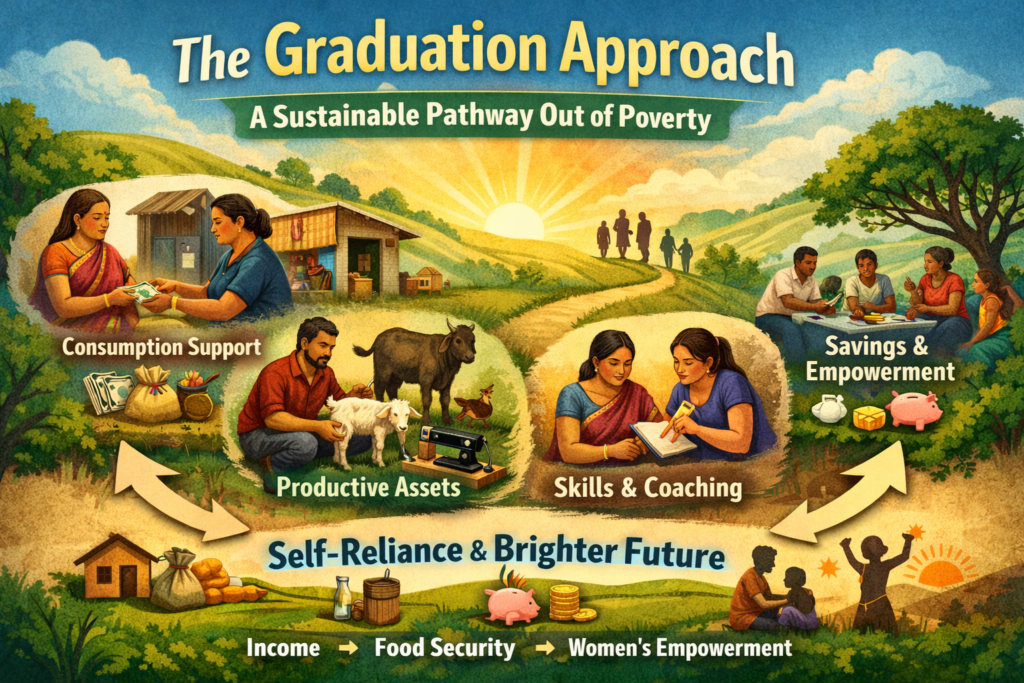
The Graduation Model operates on a set of integrated principles that collectively enable sustainable poverty exit. These include accurate targeting of ultra-poor households, temporary consumption support, transfer of productive assets, and market-relevant skills development. Continuous coaching and mentoring help households build confidence and make informed decisions, while savings promotion strengthens financial resilience. The model is intentionally time-bound, with a planned exit once households demonstrate income stability, basic savings, and reduced vulnerability—ensuring independence rather than dependency.
Why It Works for Ultra-Poor Households
The Graduation Approach is effective because it reflects the real constraints faced by ultra-poor households, particularly in Pakistan. Extreme poverty often limits risk-taking, planning capacity, and access to opportunities. By reducing immediate pressure through temporary support and gradually building livelihoods, skills, and confidence, the model creates conditions for sustainable progress. Its holistic design, combining economic, social, and behavioural components, enables households to withstand shocks, diversify income sources, and maintain gains beyond program support.
Why Poverty Graduation Programs Matter Today
Poverty hasbecome increasingly complex and persistent, drivenby economic instability, climate shocks, conflict, and widening inequality. Short-term relief mechanisms alone areno longer sufficient to address these layered challenges. Poverty graduation programs mattertodaybecause they are designed to build resilience, restore economic agency, and reduce long-term dependency. By combining immediate support with livelihood development, these programs respond to the realities of modern poverty rather than treating its symptoms in isolation.
تازہ ترین اپڈیٹس اور نوکریوں کی معلومات کے لیے ہمارا واٹس ایپ چینل فالو کریں:
چینل جوائن کریں(نوٹ: آپ کا نمبر کسی کو نظر نہیں آئے گا)
Global Poverty Challenges
Globally, poverty is no longer confined to income deprivation alone. Many households experience overlapping vulnerabilities, including food insecurity, lack of productive assets, informal employment, limited access to health and education services, and exposure to climate-related risks. Economic shocks—such as inflation, pandemics, and supply chain disruptions—have pushed vulnerable populations closer to extreme poverty. These challenges unrevealing limitations of fragmented interventions and highlighted the need for integrated poverty reduction approaches.
The Need for Long-Term Solutions
Sustainable poverty reduction requireslong-term, structured solutionsthatenable households to strengthen theirown livelihoods. Temporary assistance can stabilize consumption, butwithout skills, assets, and financial inclusion, families remain exposed to recurring shocks. Poverty graduation programs focusonbuilding economic capacity, confidence, and resilience over time, allowinghouseholds tomovebeyond survival towardself-reliance. In an era of recurring crises, long-term approaches are essential to prevent cyclical poverty and reduce reliance on perpetual aid systems.
Key Components of a Successful Graduation Program
A successful graduation program is built on interconnected components that address both immediate vulnerability and long-term economic capacity. These components are implemented in a sequenced manner, ensuring that ultra-poor households are first stabilised and then supported to build sustainable livelihoods. The effectiveness of the graduation approach lies in how these elements reinforce one another rather than operating in isolation.
Asset Transfers & Financial Support
Asset transfers form the economic foundation of the graduation program. Households receive productive, income-generating assets selected according to local market conditions and household capacity. This is complemented by temporary financial or consumption support to protect families during the initial transition phase. In contexts like Pakistan, where inflation and irregular income are common, this combination prevents distress selling of assets and allows households to focus on livelihood development.
تازہ ترین اپڈیٹس اور نوکریوں کی معلومات کے لیے ہمارا واٹس ایپ چینل فالو کریں:
چینل جوائن کریں(نوٹ: آپ کا نمبر کسی کو نظر نہیں آئے گا)
Skills Training and Livelihood Development
Skills training ensures that households can effectively manage and grow the assets they receive. Training is practical and aligned with market demand, covering technical skills, basic business practices, and income planning. Livelihood development under the graduation approach emphasises diversification, enabling households to reduce risk and strengthen income stability over time.
Coaching and Mentorship
Coaching is a central component that differentiates graduation programs from traditional poverty interventions. Regular household-level engagement provides technical guidance, behavioral reinforcement, and problem-solving support. For ultra-poor households—often constrained by low confidence and limited exposure—ongoing mentorship builds decision-making capacity, accountability, and motivation, which are critical for sustained progress.
Savings and Financial Inclusion
Savings promotion strengthens financial resilience and prepares households for life beyond program support. Graduation programs encourage small, regular savings and introduce basic financial literacy, often through informal savings groups or linkages with financial institutions. This component reduces dependence on informal credit, improves shock absorption, and supports long-term economic security.
Real-World Success Stories
Real-world implementation of the poverty graduation approach demonstrates how integrated and time-bound interventions can translate into sustainable improvements in household well-being. Across South Asia, graduation programs have shown that ultra-poor households can successfully transition from extreme vulnerability to stable livelihoods when economic, social, and behavioral constraints are addressed together.
Case Study from South Asia
In several South Asian contexts, graduation programs targeting landless and low-income households have focused on livestock rearing, home-based enterprises, and small-scale trading. Selected households received productive assets alongside temporary consumption support and skills training. Regular coaching visits helped participants manage income, reinvest profits, and overcome early setbacks. Over the program cycle, households diversified income sources, reduced reliance on informal lobour, and built basic savings—demonstrating a clear pathway out of extreme poverty within a defined time frame.
Measurable Impact on Families and Communities
The impact of graduation programs extends beyond individual households. Participating families typically experience improved food security, increased and more stable income, asset retention, and enhanced financial discipline. At the community level, these gains contribute to greater economic participation, reduced dependency on charity, and stronger local markets. Increased confidence among women participants often leads to improved household decision-making and investment in education and health, reinforcing long-term social and economic resilience.
Challenges and Lessons Learned
While poverty graduation programs have demonstrated strong outcomes, their effectiveness depends on careful design and implementation. Real-world experience shows that challenges often arise not from the model itself, but from contextual constraints, operational gaps, and external shocks. Understanding these challenges is critical for refining graduation programs and strengthening their long-term impact.
Common Implementation Barriers
One of the most frequent challenges is inaccurate targeting, where households facing temporary hardship are included while the ultra-poor are overlooked. Limited local market access can also restrict livelihood growth, particularly in remote or climate-vulnerable areas. Inadequate coaching intensity, high staff turnover, and insufficient follow-up weaken behavior change and asset utilization. Additionally, external factors such as inflation, health emergencies, and environmental shocks can disrupt income pathways and slow progress toward graduation.
Practical Solutions
Effective programs address these barriers through rigorous targeting methods that combine data with community validation. Livelihood options are selected based on local market assessments to reduce risk and improve sustainability. Strengthening field-level coaching through manageable caseloads and continuous training enhances household engagement. Programs that promote diversified income sources, savings behaviour, and contingency planning are better able to absorb shocks. These practical adjustments ensure that graduation remains a realistic and durable outcome rather than a temporary improvement.
Conclusion: Creating Lasting Change
The Graduation Model is effective because it mirrors the real lived experience of poverty in Pakistan. By combining protection, promotion, and empowerment into one coherent pathway, it offers ultra-poor families a realistic chance to rebuild their lives with dignity. Its core principles demonstrate that sustainable poverty reduction requires more than charity—it requires structured support, trust, and long-term investment in human potential.
تازہ ترین اپڈیٹس اور نوکریوں کی معلومات کے لیے ہمارا واٹس ایپ چینل فالو کریں:
چینل جوائن کریں(نوٹ: آپ کا نمبر کسی کو نظر نہیں آئے گا)
FAQs:
What is a poverty graduation program?
A poverty graduation program is a time-bound, multi-component intervention designed to help ultra-poor households move from extreme vulnerability to sustainable livelihoods. It combines temporary support with assets, skills, mentoring, and financial inclusion to enable long-term self-reliance.
Who are poverty graduation programs designed for?
These programs target the ultra-poor, including households with unstable or no income, minimal assets, and high exposure to economic and social shocks. They are particularly suited for families trapped in chronic poverty rather than temporary hardship.
How long does a graduation program typically last?
Most graduation programs operate for 18 to 36 months, following a structured sequence from stabilization to livelihood development and exit. The time-bound design prevents long-term dependency.
What types of livelihoods are supported?
Livelihoods are selected based on local market demand and household capacity. These may include livestock rearing, small retail activities, home-based enterprises, or vocational services, depending on the local context.
تازہ ترین اپڈیٹس اور نوکریوں کی معلومات کے لیے ہمارا واٹس ایپ چینل فالو کریں:
چینل جوائن کریں(نوٹ: آپ کا نمبر کسی کو نظر نہیں آئے گا)
Why is coaching considered essential?
Coaching reinforces skills, supports behavioral change, and helps households solve problems as they arise. Regular mentoring is particularly important for ultra-poor households with limited exposure to financial planning and enterprise management.
How does the program reduce the risk of households falling back into poverty?
The graduation approach reduces relapse by promoting diversified income sources, savings habits, and financial discipline. These elements improve resilience to economic shocks and emergencies.
What does “graduation” mean in this context?
Graduation refers to a household achieving basic income stability, asset retention, regular savings, and reduced vulnerability, allowing it to exit the program without ongoing external support.
Are poverty graduation programs relevant in today’s economic conditions?
Yes. Rising inflation, climate risks, and employment instability make integrated and sustainable poverty solutions more important than short-term relief, increasing the relevance of graduation programs today.
Can graduation programs be adapted to different countries or regions?
The graduation approach is highly adaptable. While the core framework remains consistent, asset choices, training methods, and implementation strategies are tailored to local economic and social contexts.