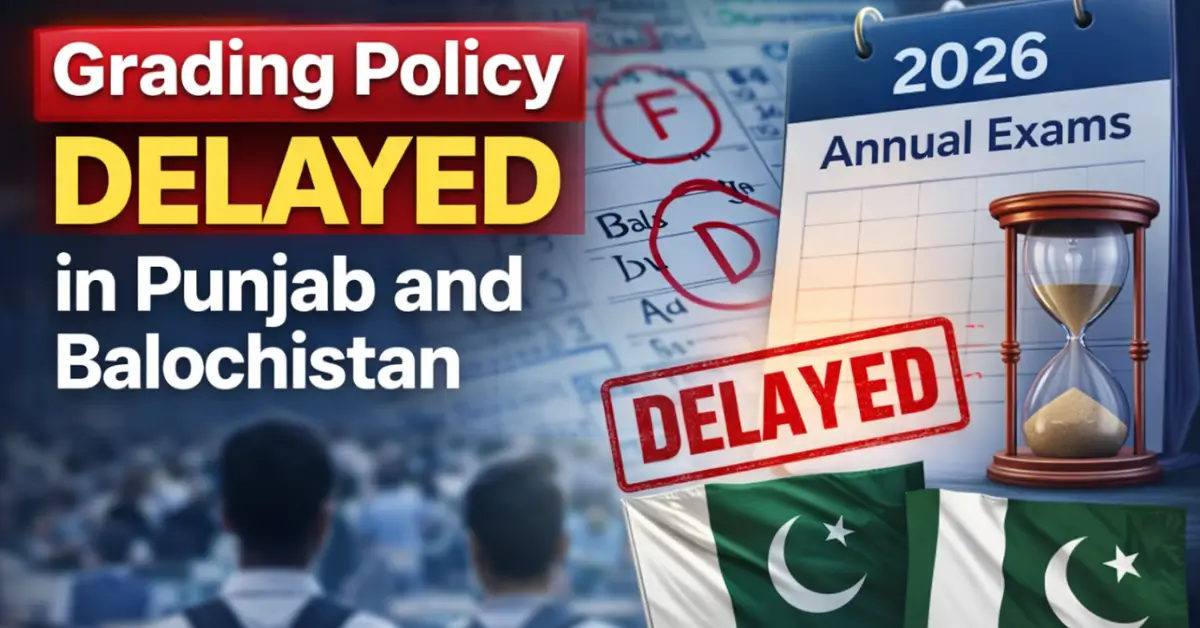
The New Matric and Inter Grading Policy was introduced to improve Pakistan’s examination system and create uniform standards across the country. Although the policy has been approved at the national level, its implementation now faces delays in Punjab and Balochistan. This situation has created uncertainty as the 2026 annual exams approach.
What Is the New Grading Policy?
The updated policy brings major changes to Matric examinations and Intermediate examinations, especially for Classes 9 and Classes 11.
Key changes include:
تازہ ترین اپڈیٹس اور نوکریوں کی معلومات کے لیے ہمارا واٹس ایپ چینل فالو کریں:
چینل جوائن کریں(نوٹ: آپ کا نمبر کسی کو نظر نہیں آئے گا)
- Increase in passing marks from 33 percent to 40 percent
- Introduction of separate passing requirements for each subject
- Revised grading criteria to improve evaluation standards
The purpose of these reforms is to strengthen academic performance and align the system with modern assessment criteria.
National-Level Approval
The policy was approved by the Inter Board Committee of Chairmen (IBCC) and the Inter-Provincial Education Ministers Conference (IPEMC). It was planned for nationwide implementation across Pakistan, including Azad Kashmir, starting from the academic session 2026.
Education authorities emphasized that uniform enforcement is necessary to ensure fairness in higher education admissions.
Provinces That Have Implemented the Policy
So far, the following regions have issued a formal notification and started preparations:
تازہ ترین اپڈیٹس اور نوکریوں کی معلومات کے لیے ہمارا واٹس ایپ چینل فالو کریں:
چینل جوائن کریں(نوٹ: آپ کا نمبر کسی کو نظر نہیں آئے گا)
- Sindh
- Khyber Pakhtunkhwa
- Islamabad
These provinces are moving forward with the new policy framework to avoid last-minute confusion.
Provinces Facing Delay
Despite national approval, Punjab and Balochistan have not yet issued official notifications. The delay in regulatory approval may create implementation challenges as exams draw closer.
Without synchronized adoption, students in different provinces could face different standards in the same academic year.
Impact on Students and Universities
The delay could affect:
تازہ ترین اپڈیٹس اور نوکریوں کی معلومات کے لیے ہمارا واٹس ایپ چینل فالو کریں:
چینل جوائن کریں(نوٹ: آپ کا نمبر کسی کو نظر نہیں آئے گا)
- University admissions
- Preparation of merit lists for undergraduate programs
- Consistency in merit calculation
According to Dr Ghulam Ali Mallah, Executive Director of the Inter Board Committee of Chairmen, having different grading systems in different provinces may cause discrepancies in evaluation standards.
Universities rely on consistent grading to prepare fair merit lists. If provinces follow different systems, it may lead to confusion for students and institutions.
Why Uniform Implementation Matters
A single grading system ensures:
- Equal opportunity for all students
- Clear and fair academic standards
- Smooth coordination between examination boards
- Transparency in higher education admissions
Without synchronized enforcement, the credibility of the education system could be questioned.
Conclusion
The New Matric and Inter Grading Policy is an important step in education reforms Pakistan. However, the delay in Punjab and Balochistan has raised concerns. For smooth nationwide implementation, all provinces must issue timely notifications and coordinate closely.
Students preparing for the 2026 annual exams should stay updated through their respective boards while authorities work toward consistent enforcement across the country.